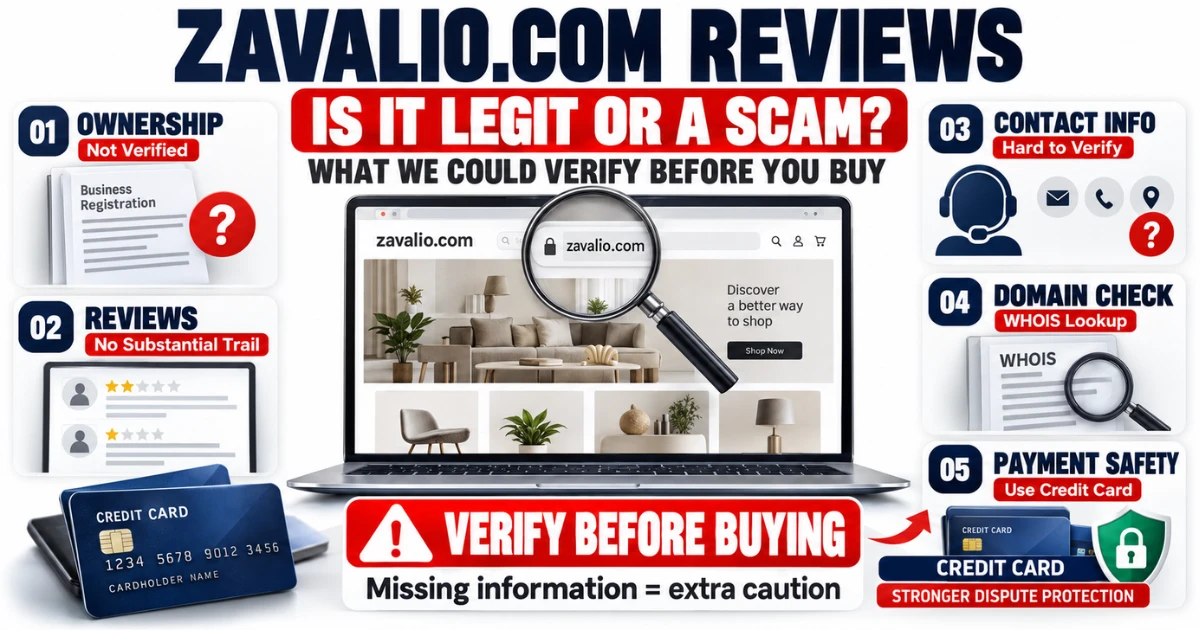
Is zavalio.com legit or a scam? After checking domain records, review platforms, and dozens of search results, the honest answer is: there isn’t enough verified information to call it either way — and that gap itself is a red flag worth understanding.
If you searched “zavalio.com reviews” hoping for a quick yes-or-no answer, here’s the short version. We could not find a real business address, a working customer service history, or genuine third-party reviews tied to zavalio.com. What we did find were several thin, repetitive articles about the site with no verifiable facts behind them. This guide explains what that means for you and how to protect yourself before you buy from zavalio.com or any unfamiliar online store.
What Is Zavalio.com
Zavalio.com appears in search results as an online storefront, but solid details about the company behind it are hard to pin down. There’s no clear founding date, no verified business registration, and no consistent “About Us” story across the sources that mention it.
Why Verified Details Matter
A legitimate retailer usually has a traceable business history: a registered company name, a physical address, and a support line that actually answers. When those pieces are missing or inconsistent, it’s a sign to slow down before entering payment details.
What We Could Not Verify About Zavalio.com
We looked for the basics that any real e-commerce site should have on record.
Missing Ownership Information
We found no confirmed WHOIS registration data, no named company, and no verified physical address for zavalio.com. Real retailers list this information because consumer protection laws in the USA often require it.
No Genuine Review History
Trustworthy review platforms like Trustpilot and the Better Business Bureau (BBB) rely on verified, dated customer feedback. We found no substantial, verifiable review trail for zavalio.com on either platform — only a scattering of vague blog posts describing the site in generic terms.
Why Thin, Repetitive Articles Are a Warning Sign
One thing stood out during this research: several articles about zavalio.com read almost identically — same structure, same vague praise, same short “FAQ” section, published around the same time on low-authority websites.
The Pattern Behind Synthetic Reviews
This pattern matches a known tactic where content farms publish look-alike “review” articles to make an unfamiliar site appear more established in search results than it actually is. The Federal Trade Commission (FTC) has flagged fake and manipulated online reviews as a growing consumer risk, which is part of why the agency finalized a rule in 2024 banning the sale or purchase of fake reviews.
What Real Reviews Look Like Instead
Genuine reviews are usually specific: they mention order dates, shipping times, product condition, and support interactions. Vague, interchangeable praise with no specific details is a signal the content may not reflect real customer experience.
How to Check Domain Age and Ownership Yourself
You don’t need special tools to do a basic background check on any store, including zavalio.com.
Free WHOIS Lookup Tools
Sites like ICANN Lookup or who.is let you check when a domain was registered and, sometimes, who registered it. A domain that’s only weeks or months old is not automatically a scam, but it is a reason to be more careful.
Cross-Checking the Business Name
Search the company name (not just the website name) plus the word “complaint” or “scam.” If no business name is listed anywhere on the site, that absence itself is worth noting.
Common Red Flags Seen on Unverified Retail Sites
While we can’t say for certain that zavalio.com shows every one of these signs, these are the patterns consumer protection researchers consistently find on unverified online stores.
Countdown Timers and Urgency Tactics
Fake urgency — “only 3 left,” countdown clocks that reset, “sale ends today” banners that never actually end — is a common pressure tactic designed to rush a purchase decision.
Prices That Are Too Far Below Market Rate
Deep discounts on brand-name or trending products, well below what any retailer’s margin could support, are one of the most consistent signals researchers point to in fraudulent storefronts.
No Real Customer Service Trail
A legitimate seller has a support email that gets answered, a phone number that connects to a real person, or live chat with a documented history. If contact attempts go unanswered, that’s a serious warning sign.
Zavalio.com Pricing: What Shoppers Should Know
Without verified product listings or a confirmed catalog, we can’t compare zavalio.com’s specific pricing to competitors. What we can say is that any online store advertising steep, sitewide discounts deserves the same scrutiny you’d give an unsolicited email offer.
A Simple Price Check Habit
Before buying, search the exact product name on a marketplace you already trust, like Amazon or the brand’s own site. If the price gap is large, treat that as a reason to research further, not a reason to buy faster.
Return and Refund Policies: What to Look For
A store’s return policy tells you a lot about how seriously it treats customers.
Signs of a Workable Policy
Look for a clear return window (30 days is common in the USA), a physical return address, and a policy that doesn’t bury conditions in confusing language.
Signs of a Policy Designed to Block Refunds
Watch for policies that require international return shipping at the buyer’s expense, vague “processing time” language with no fixed timeline, or no written policy at all.
Is It Safe to Enter Payment Information on Zavalio.com
This is the question that matters most before checkout.
Why Payment Method Matters
The FTC specifically recommends using a credit card, not a debit card or bank transfer, for online purchases from unfamiliar sellers, because credit cards offer stronger dispute rights if something goes wrong.
Checking for Basic Site Security
An SSL certificate (the padlock icon and “https”) is a baseline requirement, but it only confirms the connection is encrypted — it does not confirm the business itself is legitimate. Don’t treat a padlock icon as proof of trustworthiness on its own.
How Rebrand-and-Repeat Storefronts Operate
Consumer protection researchers have documented networks of short-lived online stores that share a common pattern: similar site templates, similar naming conventions, and a habit of disappearing once complaints build up, only to reappear under a new domain.
Why This Matters for Unfamiliar Names
A brand-new or obscure store name with no search history before a certain date is not proof of wrongdoing, but combined with missing ownership info and copy-paste reviews, it’s a pattern worth taking seriously.
What to Do If You Notice the Pattern
If a site shares design elements, product photos, or even review wording with other stores you’ve seen flagged as risky, treat that as added reason to verify before buying.
How to Verify Any Online Store Before You Buy
These steps work for zavalio.com or any unfamiliar retailer.
The Five-Minute Background Check
Search the business name plus “reviews,” check the WHOIS registration date, look for a real address, and check whether the return policy is specific and reasonable.
Trust Your Hesitation
If something feels off — vague contact info, reviews that all sound the same, prices that seem too good — that instinct is worth listening to before you check out.
What to Do If You Already Ordered From Zavalio.com
If you’ve already made a purchase and are concerned, here’s what actually helps.
Dispute the Charge With Your Card Issuer
Under U.S. law, you have the right to dispute a credit card charge if goods never arrive or don’t match what was advertised. Contact your card issuer directly and reference the order confirmation and any correspondence.
Report It to the FTC
You can file a report at ReportFraud.ftc.gov. The FTC received over 2.6 million fraud reports in a recent year, and each report helps build the case record used to flag repeat offenders, even though the agency can’t resolve individual disputes directly.
Save Every Piece of Documentation
Keep the order confirmation email, any tracking information, and screenshots of the product listing. These are exactly what your card issuer will ask for during a dispute.
Final Verdict: Should You Trust Zavalio.com
Based on what’s currently verifiable, zavalio.com does not have the track record — clear ownership, genuine reviews, traceable support history — that would let us call it confirmed legitimate. It also doesn’t have hard evidence proving it’s a scam. What it has is an information gap, filled mostly by low-quality, repetitive articles that don’t hold up as real research.
The safest approach: treat any purchase from zavalio.com the way the FTC recommends treating any unfamiliar seller — use a credit card, verify the return policy before buying, and keep records of everything.
FAQ’s
Is zavalio.com a legitimate company?
There is currently no verified business registration, address, or ownership record publicly available for zavalio.com, so its legitimacy cannot be confirmed either way based on available information.
Are the reviews about zavalio.com trustworthy?
Most articles referencing zavalio.com follow a generic, repetitive format without specific, dated customer experiences, which is a pattern commonly associated with low-quality or synthetic content rather than genuine reviews.
What payment method is safest if I order from zavalio.com?
A credit card is safer than a debit card or bank transfer for any unfamiliar online store, because credit cards carry stronger legal dispute rights under U.S. consumer protection rules.
How do I get my money back if zavalio.com doesn’t deliver?
Contact your credit card issuer to dispute the charge, and file a report with the FTC at ReportFraud.ftc.gov. Save your order confirmation and any tracking details as evidence.
How can I check if zavalio.com is safe before ordering?
Run a free WHOIS lookup to see how old the domain is, search the business name plus “complaint” or “scam,” and check whether the site lists a real physical address and working support contact.
Should I avoid zavalio.com entirely?
Given the lack of verifiable business information, the safest approach is caution: if you choose to order, use a credit card, keep all documentation, and avoid entering more personal information than necessary at checkout.

Bisma Ali is the admin and author of BestWishes2. She writes simple, heartfelt wishes to help people express their feelings with ease.